 Author : Alma
Flor Ada
Author : Alma
Flor Ada2nd Grade and Up
Author : Alma
Flor Ada
2nd Grade and Up
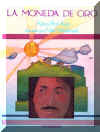
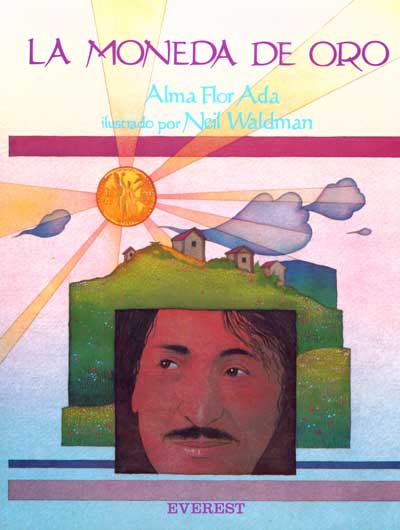
La moneda
de oro
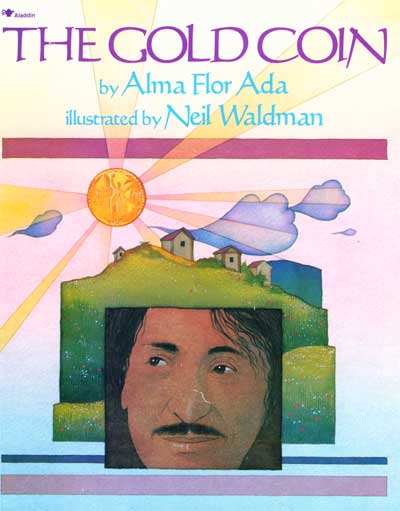
The Gold Coin
 La
moneda de oro, Softcover, Spanish, Book, Alma
Flor Ada,
2nd Grade and Up,
9788424133641, $9.50
La
moneda de oro, Softcover, Spanish, Book, Alma
Flor Ada,
2nd Grade and Up,
9788424133641, $9.50
La moneda de oro - The Gold Coin,
Bilingual, Storytelling CD, Alma
Flor Ada,
2nd Grade and Up, $19.95 Listen
The Gold Coin,
Softcover, English, Book, Alma
Flor Ada,
2nd Grade and Up,
9780689717932, $6.99
$277.52 for the Story Collection Green Books and CDs Spanish Set, Including 20%-Off, Free Shipping, and No Sales Tax : 1 Hardcover Spanish Book, 15 Softcover Spanish Books, 2 Softcover Spanish Oversized Books, 1 Spanish Big Book, 2 Spanish Storytelling CDs, 1 Bilingual Storytelling CD, and 1 Spanish Music CD

 American Booksellers
Association, Pick of the List
American Booksellers
Association, Pick of the List
Center for Latin
American Studies, America´s Commended List
Christopher
Award Medal
National Council of
Social Studies and the Children’s Book Council, Notable Book in the Area of
Social Studies
This Christopher Medal winner has already become a classic. While it reads as a folktale, it is an original story. Trying to steal Doña Josefa’s gold, Juan follows this generous curandera through the countryside. In the process, he is affected by the beauty of the natural world around him, the goodwill of the people who work the fields, and the spirit of the healer he is pursuing. Neil Waldman’s poetic watercolors sensitively convey the beauty and diversity of the Central American landscape, as well as the inner transformation that Juan undergoes.
Author’s Note : This was my first book published in English by a major American publisher. I owe my daughter, Rosalma Zubizarreta, the encouragement to pursue many publishers until one was willing to publish the story. Without her enthusiasm for this story, which she wanted to see in the hands of every child in the United States and her gentle support after each rejection, the book would probably had been published abroad, in Spanish, and probably never reach the wide audiences it has reached. The story was born one night, while returning home in the San Francisco Bay Area, after working with migrant farm-working parents until late in the Watsonville-Salinas area. It appeared in front of my eyes, as if it were a movie, and I saw the characters acting and speaking the whole story. When I arrived home I jotted down the whole story before falling asleep. The next morning it all seemed like a dream, but the pages were there, with the full text.
It has been an immense joy that Rosalma’s wishes materialized, as the book has been included in most major reading series and in many reading lists. The letters I have received from children and adolescents about this book are very moving and I have enjoyed visiting many classes which had read the book where we have talked about our personal richness, and students have shown their understanding of true values. Probably the most extraordinary experience in connection with this book was to attend the performance staged by Sylvia Dorta-Duque de Reyes (San Diego County Office of Education) of The Gold Coin performed by students in the main plaza of the Zapotec village of Teotitlán del Valle in Oaxaca.
 Listen to Vienna Rose read
The Gold Coin to you. A marvelous example of the magical encounter
between a child and books that we wish for all children. And here's an earlier
reading by Vienna Rose.
Listen to Vienna Rose read
The Gold Coin to you. A marvelous example of the magical encounter
between a child and books that we wish for all children. And here's an earlier
reading by Vienna Rose.
Publishers Weekly : An elderly woman, Dona Josefa, sits in her hut, holding a gold coin. "I must be the richest woman in the world," she says to herself. But unbeknownst to her, a thief, Juan, crouches at her window, watching and listening. When Dona Josefa leaves, Juan ransacks the hut but fails to find her treasure. Tracking the woman across the countryside, he misses her again and again--coming instead upon many people who have been helped by her. And when the thief finally does catch up with her, he is surprised to find that he, too, has been touched by her simple goodness. Set in South America, this beautifully designed book features an unusual, rewarding fable and Waldman's ( Nessa's Fish ) lovely, stylized watercolors. It's a rich collaboration, worthy of repeated readings. Ages 5-8.
School Library Journal : Kindergarten-Grade 3-- Juan has been a thief for many years. He is pale and bent from creeping about at night, and that's what he's doing the night he peeks into Dona Josefa's hut. She is holding a gold coin and says that she must be the richest woman in the world. Then and there, Juan determines to steal that coin, and any others she may have. It is a decision that changes Juan's life forever. This gentle story of redemption, ably translated by Randall, is structurally at once cumulative and circular, and is ideally suited for memorization and telling. It will work well as a read-aloud, too. Waldman's clean, pale watercolors have an art nouveau feel, and are large enough to be seen at story times. Whether told, read to a group, or shared one-on-one, the tale of Juan's search for an old woman's treasure makes an important point in a concise and satisfying manner.
 Hungry Mind
Review : “The Gold
Coin takes the integration of story and illustration to the level of fine art.
With marks of a classic fable, this original tale by Alma Flor Ada describes the
changes in a thief as he mistakenly pursues the golden treasure of a
“curandera” or traditional healer. In graceful prose Ada presents a series
of adventures, each ending with the gold just out of reach of the thief. The
episodes proceed in a tension and release rhythm; gradually Juan the thief is
transformed through kindness. “Later, when the little girl took him by the
hand to show him a family of rabbits burrowed under a fallen tree, Juan’s face
broke into a smile. It had been a long, long time since Juan had smiled.” Neil
Waldman’s illustrations are magnificent. The text is printed on photographed
watercolor paper, and each page is tinted in a rainbow wash. Strong graphic
elements unite facing pages. Postage stamp-size drawings hint at the next part
of the story. The full-page watercolor paintings gradually reveal more subtle
facial features as the thief opens his heart to those around him. Of the four
books [reviewed in this article] The Gold Coin exhibits the strongest unity of
text and illustration, a synthesis equaled by few books of any genre. Each book
however, gives us a view of life drawn from within the culture of la Raza. These
authentic points of view will help increase awareness and appreciation of the
beauty of the cultures at the heart of the Americas.”
Hungry Mind
Review : “The Gold
Coin takes the integration of story and illustration to the level of fine art.
With marks of a classic fable, this original tale by Alma Flor Ada describes the
changes in a thief as he mistakenly pursues the golden treasure of a
“curandera” or traditional healer. In graceful prose Ada presents a series
of adventures, each ending with the gold just out of reach of the thief. The
episodes proceed in a tension and release rhythm; gradually Juan the thief is
transformed through kindness. “Later, when the little girl took him by the
hand to show him a family of rabbits burrowed under a fallen tree, Juan’s face
broke into a smile. It had been a long, long time since Juan had smiled.” Neil
Waldman’s illustrations are magnificent. The text is printed on photographed
watercolor paper, and each page is tinted in a rainbow wash. Strong graphic
elements unite facing pages. Postage stamp-size drawings hint at the next part
of the story. The full-page watercolor paintings gradually reveal more subtle
facial features as the thief opens his heart to those around him. Of the four
books [reviewed in this article] The Gold Coin exhibits the strongest unity of
text and illustration, a synthesis equaled by few books of any genre. Each book
however, gives us a view of life drawn from within the culture of la Raza. These
authentic points of view will help increase awareness and appreciation of the
beauty of the cultures at the heart of the Americas.”
Kirkus Review : “Juan, a confirmed thief, overhears Doña Josefa referring to herself as “the richest person in the world”; moreover, he sees a gold coin in her hand. But before he can steal it, she hurries away with the two men, leaving nothing of value that he can find in her humble hut. Juan follows her trail, only to discover that she has always gone on another errand of mercy just before he arrives. The people she’s helped are willing to lead him to her –but each time there is work to be finished first, and Juan (hoping to hurry his guide) joins in. As he labors and shares food with these humble folk, Juan becomes healthier in body and mind; still, when he finally catches up with Doña Josefa, he demands her gold. She gives it to him freely –thus completing his moral transformation: he returns it as a gift for the next patient. Like a folk tale, this original story builds naturally to its satisfying conclusion; its long text should appeal well beyond the picture-book age. Waldman’s watercolors, with stylized forms displayed against varying backgrounds of romantic sunset hues, gently suggest both the story’s universal tone and its Latin American setting.”
“An unlikely friendship and a new perspective on life emerge in The Gold Coin, a picture book by Alma Flor Ada. […] Students laughed at the frustrated thief but were moved by the outcome of the story and the thief discovery that friendship is a greater treasure than gold. They spoke enthusiastically about Neil Waldman’s full-page, pastel illustrations.
Retell: A thief discovers a woman who claims to be the “richest person in the world.” He ransacks her hut but fails to find her gold. He goes on a quest to find the woman and her gold. What he finds instead are people who teach him that being rich has little to do with gold. Topics: gold, greed, thieves, kindness, hard work, acceptance. Units of Study: Character, Social Issues, Talking and Writing about Texts. Tribes: mutual respect. Reading Skills: prediction, interpretation, inference, empathy. Writing Skills: incorporating the rule of three. My Thoughts: I first discovered this story when I went to a Great Books training years ago. I’ve since used it a few times during the Character unit. It is a great text for examining how people can change because of their relationships with other people. It’s a great text to use when you are launching whole class conversation during and after read alouds.
Story
Collection Green Books and CDs
: